tasty morsels of goodness on open platforms, developer relations and motherhood 2.0

Tuesday, October 19, 2010

Don't Be a Lemming: You Can be Open and Integrated

"In reality, we think the open versus closed argument is just a smokescreen to try and hide the real issue, which is, “What’s best for the customer – fragmented versus integrated?”

- Steve Jobs, Apple Q4 2010 Earnings Call

"You keep using that word. I do not think it means what you think it means."

- Inigo Montaya

First, to appease the many fanboys, colleagues, and friends that may take issue with this post, I have the utmost respect for Apple as a company that walks its talk when it comes to real innovation. According to its fiscal Q4 2010 earnings report that came out yesterday, crossing the $20B revenue threshold for the first time ever, over 60% of its revenue today is coming in from products that didn't even exist 3 years ago. To quote Asymco, the source of this chart below, remember Apple before the iPod? This is an impressive record of product development and innovation leadership. They've also listened to developers and backed off of their 3.1.1 TOS mistake after evaluating for five months, and created the iAds opportunity for developer app monetization. Well done.
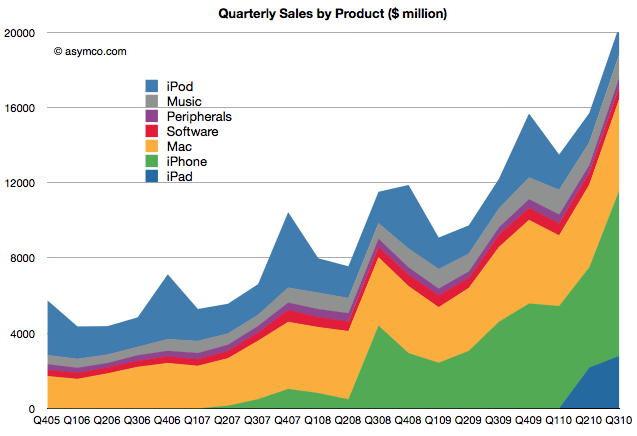
But just because you have a product genius for a leader, trying to reframe the open vs closed debate into a fragmentation vs integration debate is "disingenuous," to use Jobs' own words. First, I agree with Eric Nolin's post as he chronicles the overuse of "open" to the point where the buzz threatens to "openwash" everything. Second, by painting Microsoft Windows and Plays for Sure music strategy as proof that "Open doesn't Win," Jobs himself just might be at the pinnacle of personal disingenuity, as pointed out by Kevin Marks. Open. This word does not mean what he thinks it means.

Being open does not make a bad product strategy better. But I reject the false choice that good product strategy needs to be either open or integrated. Parts of the Android, Chrome, #newtwitter, and Facebook OpenGraph strategies show that you can have a balance of both. You will never get a 100% overlap between open and integrated, but you can -- and should -- have elements of both on your product and platform strategies. Too closed or too fragmented doesn't work.

So, if you are truly a fan of Apple, call Steve Jobs on his framing of the open vs closed debate. Don't be a lemming. Any who follow his logic of Open cannot also be Integrated unquestioningly are blindly following a benevolent dictatorship of product vision where you are being offered the integrated experience of those who know better.


Labels: , , , , , , , , , , , ,

Monday, June 28, 2010

Help your developers make money

(Reprint from my Mashery blog post)

Coders who work with APIs often have a strong entrepreneurial streak. Many have tried out just about every monetization model out there for app development. One-time paid subscription. Affiliate. "All-you-can-eat" monthly paid subscription. Advertising. Free-mium. Custom development fees. Just in the last two months, I've spotted some new trends in monetizing app development thanks to the help of a couple of smart guys, Steve and Neil. Both have great insights around how platform providers who offer APIs can focus on creating value for developers who build great apps.

WWDC 2010 Keynote
Photo credit: WWDC Live Keynote Coverage, gdgt.com
1) Steve the Platform Provider: As shared at WWDC earlier this month, “Why are we doing iAds? For one simple reason: to help developers earn money so they can continue to create free and low-cost apps for users.” Steve recognizes that the deflationary nature of App Stores for mobile application developers has even the largest platform providers looking for alternative revenue models for app builders. The downward pressures on paid-app fees have interesting parallels with the music industry, where downloads are loss leaders for a variety of upsell and marketing opportunities. As confirmed in The Economist, in each case some make it big, but most never become hits. And apart from evergreens, such as games, utilities and programs to use Facebook and Twitter, even the most successful mobile apps often quickly fade into obscurity.

With emerging ad platforms like iAds, AdMob, and Promoted Tweets on the rise, it is clear that platform providers understand that more developers building great apps for customers need a clear path forward for making money. More attention will be given by app developers on how to use advertising (over subscription fees) to monetize their app development. This will have big consequences for the landscape of app development looking forward.

2) Neil the Coder: Neil Mansilla, a successful Web application developer, gave his own point of view at our unconference API Panel Discussion at Web 2.0 Expo in San Francisco last month. Neil shared with our audience that that platform providers offering him marketing opportunities to potential users of his app have turned out to be more valuable than structural differences in revenue share or access fees. When an Apple or Facebook or eBay or Salesforce.com select an app to showcase for their customers, the resulting awareness and downloads/registrations are at a scale developers generally never could have afforded on their own.
So, Steve signaled that advertising is positioned to play an increasingly important role for app monetization for developers, implicitly acknowledging the downward pricing pressures on paid apps. While Neil gave me a lesson in the value of app marketing to app developers, sharing that in many cases the most valuable offer that platform providers can extend to developers is actively promoting the best quality apps to their customer base.

Savvy app developers out there are quickly going to get a lot more comfortable with the role that marketing and advertising has in the overall value of their app development projects. Savvy Web and mobile platform providers with APIs should pay close attention.

Labels: , , , , , , ,

Monday, January 04, 2010

2010 prediction: cloud to benefit from less haze and hype

The warning signs have been around since about 2008. My own truly worrying signal that the increasing buzz around cloud has officially kicked up too much dust came when, flipping through my beloved Economist recently (how will my new Kindle ever give me that crisp, snappy-paged satisfaction?), I read through The Economist Cloud Briefing: "Clash of the Clouds: The launch of Windows 7 marks the end of an era in computing—and the beginning of an epic battle between Microsoft, Google, Apple and others."

Attribution: Illustration by Ian Whadcock, Economist.com

Let's get this straight. The Economist -- as close to a journalistic beacon of integrity and excellence as exists, IMHO -- "and othered" Amazon to include Apple in its Top 3 battling it out for cloud dominance. DRM-imbued, closed loop, opaque Apple. Then, led its list of Top 3 cloud titans with Microsoft, who arguably is just getting started with cloud efforts, and is not yet apace with Google or Amazon. Or Salesforce.com for that matter. Isn't this the business equivilant of awarding Obama the Nobel Peace Prize, signalling sky-high expectations of players, most of whom haven't delivered much of anything yet?

You'll need to read the article to get a sense of the restricted way the author seems to define cloud computing solely as a mainframe-to-PC-to-cloud evolution, completely missing the context of cloud as a platform that is leveraged by other parties to create customer-facing applications (nicely echoed by vzach and AOtto -- benefits of the Web edition include the exposing of kindred reaction. :-)) Dion Hinchcliffe of ZDnet makes more accurate, compelling points that the clash of the clouds will be a "winner-takes-all" battle similar to previous platform battles, where immature battlefield rules of engagement, standards and definitions are still being solidified.

On top of leading and well-respected business publications clouding our understanding, additional murkiness came in the form of a pre-holiday duststorm around the December 18th Rackspace "cloud failure" that brought down major sites for the better part of an hour (again) when Rackspace failover plans seemingly did not include data center and peering redundancy for AT&T when their backbone failed ("FailT&T is the Ford Pinto of the internet" via @shamptonian.) Isn't redundancy a key prerequisite for something to be considered cloud, therefore making this not a cloud failure, but a hosting redundancy failure? (read: is it OK for virtual private server hosting to be re-branded as ‘cloud’ hosting when it is not in fact cloud-based via @john_mason_?)

My wish in 2010 if for cloud standards to grow up a bit, and for cloud as a platform to become less "developer-beware". May the best titan win, may they be as open as possible but not more open, and may cloud not suffer the fate of becoming the most overhyped, least delivered upon term of 2010.

Labels: , , , , , , , , , , ,